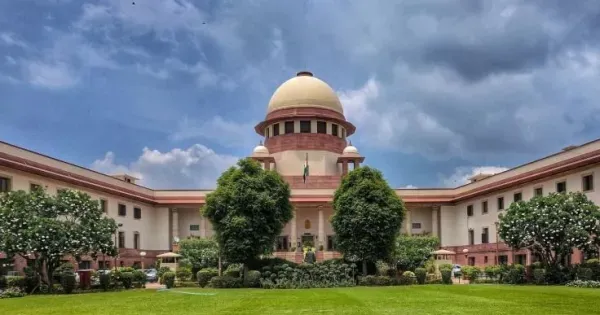
The Supreme Court has transferred to itself three criminal review petitions, taking a tough stance on the Allahabad High Court not delivering its verdict despite reserving its verdict for six years. Due to the pendency of these cases, the trial of a murder case of 1994 was stalled for years.
Invoking Article 139A of the Constitution, the bench of Justice Vikram Nath and Justice Sandeep Mehta said that normally the courts do not use such extraordinary power in the petition under Article 32, but in this case the extraordinary delay in justice is directly impacting the right of the aggrieved party to speedy justice.
The bench said that the hearing on the three criminal review petitions was completed in the Allahabad High Court on 5 February 2020 and the verdict was reserved on the same day. After this, no decision has been given till now and the cases kept getting listed again and again and postponed. Recently, the cases also came on the list on 4 February 2026, but were then postponed.
The Supreme Court said in its order that due to the stay on these petitions, the ongoing case in the trial court could not proceed further, due to which the criminal proceedings to the incident of May 30, 1994 were stalled for decades.
The bench said, “The pendency of these cases is not merely a personal dispute between the parties. It is an important question as to how long delays in trials affect the credibility of the judicial process and can cause irreparable harm.”
On this basis, the Supreme Court ordered to call all the three review petitions pending in the Allahabad High Court under Article 139A and decided to hear them by combining them with the present writ petition. The court directed the Registrar General of Allahabad High Court to send all the records to the Supreme Court within three weeks.
This petition was filed by the legal heir of the deceased under Article 32. The petition raised the issue of violation of the right to speedy justice under Articles 14 and 21.
The case began with an FIR registered in 1995, in which nine people were accused under sections 147, 148, 149, 302 and 307 of the Indian Penal Code (IPC).
A case against another accused was registered in the year 2004, as he was earlier absconding. In 2008, the Uttar Pradesh government proposed to withdraw the case against accused Chhotey Singh and in 2012 filed an application under section 321 of CrPC. Later the government also demanded withdrawal of the case against all the accused.
On 19 May 2012, the trial court allowed withdrawal of prosecution against Chhotey Singh, but rejected the demand to withdraw the case against other accused.
Challenging this order, the accused filed criminal review petitions in the High Court, while the aggrieved party challenged the decision to withdraw the case against Chhotey Singh. After the hearing of these petitions was completed in Allahabad High Court, the decision was reserved on 5 February 2020. At the same time, the hearing of the case was also put on hold, which continues till today.
The Supreme Court also intervened on another aspect to this matter on July 15, 2024. At that time, the court had canceled the order of the High Court and directed to re-evaluate the case and expressed serious concern over the delay in the trial.
The Supreme Court now said that unless the pending revision petitions are decided, effective implementation of the 2024 order is not possible. Therefore, it became necessary to transfer these cases to us to make the justice process effective and ensure speedy justice.
Contact to : xlf550402@gmail.com
Copyright © boyuanhulian 2020 - 2023. All Right Reserved.