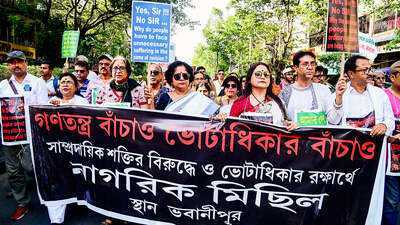
In an interview to Alt News, Sabir Ahamed, founder of SABAR Institute in Kolkata, has articulated concerns about the Special Intensive Revision (SIR) of electoral rolls in West Bengal, arguing that the findings indicate design bias and large-scale exclusion of voters.
Both Alt News and SABAR Institute have analysed Election Commission of India (ECI) data relating to the Bengal SIR and identified troubling trends. In an interview released on Monday, 13 April (link below), Ahamed explains why the SABAR study leads him to believe that the SIR process disproportionately targeted Muslims in the state.
“The introduction of categories like ‘under adjudication’ unnecessarily complicated the process… and despite Supreme Court directions, the ‘logical discrepancy’ list is not available in the public domain in Bengal, even though such data exists for states like Uttar Pradesh,” Ahamed told Alt News.
“Our initial estimates suggest this process has already cost ordinary people around Rs 4,000 crore. If cases move to tribunals, the financial burden will increase further due to legal expenses. This raises a basic question: why should citizens bear the cost of a flawed process initiated by the state?” he asked.
Ahamed said he does not believe any design bias in the algorithm used by the ECI could have originated purely within administrative structures. However, he pointed out that if the work was outsourced, prompts could potentially be designed or manipulated to produce specific outcomes.
This raises the question of which agency developed the algorithm and what methodology was followed. When introducing the SIR in Bihar, the ECI had claimed that a commissioned study had flagged anomalies in electoral rolls. Although this claim was placed before the Supreme Court, the identity of the agency that conducted the study and its methodology have not been made public. It is also unlikely, Ahamed suggested, that the ECI would disclose the identity of the agency that developed the SIR algorithm.
“Traditionally, the Election Commission emphasised transparency through social audits and public hearings — publicly disclosing voter numbers, reasons for exclusion, and pathways for re-inclusion. There was a time when even homeless persons were enabled to vote by assigning electric poles as addresses. Today, however, even multiple identity documents are proving insufficient to secure one’s place on the electoral roll,” Ahamed said.
A summary of points made by the SABAR Institute founder in the interview provides further insight into the functioning of SIR in West Bengal:
• According to the voter list published in December 2025, areas with large Muslim populations recorded high mapping percentages. In districts such as Malda, Murshidabad and other border regions, less than 2 per cent of the Muslim population remained unmapped. In contrast, Scheduled Caste-dominated regions such as the Matua belt recorded a significantly higher unmapped population at 14.3 per cent. Urban centres such as Kolkata also saw higher levels of unmapped voters, particularly among migrant populations.
• The introduction of the 'logical discrepancy' mechanism marked a turning point. While the proportion of Muslim voters initially reflected their share among mapped voters, the percentage of Muslims among those flagged under 'logical discrepancy' was significantly higher than their population share.
• It is unlikely, Ahamed argued, that the conceptualisation and technical articulation of such a tool originated entirely within the administrative system. Once outsourced, systems become vulnerable to design bias. AI tools are shaped by the parameters they are given; inserting specific prompts or instructions can influence outcomes. According to Ahamed, the system may have been primed with prompts that disproportionately flagged Muslim names.
• Many discrepancies appear to arise from spelling variations that are linguistically common. Prefixes such as 'Sheikh' can be written in multiple forms, while names such as 'Ahamad' and 'Ahmad' represent normal transliteration differences rather than identity inconsistencies. Yet such variations are reportedly sufficient to trigger flags.
• The language layer further complicates the issue. Except for Kolkata, electoral rolls across West Bengal are published in Bangla. The process of translating these names — reportedly using automated tools such as Google Translate or similar systems — can introduce distortions. The methodology for this translation has not been clearly explained.
• For instance, the name Abdul Jabbar, written in Bangla as 'আ: জব্বর', could be rendered as 'Ah! Jabbar' without contextual interpretation. Such outputs may then be flagged as logical discrepancy. Similar distortions have affected other names, including instances involving individuals such as Sentu Das and even family members of public figures such as Justice Joymalya Bagchi. However, these appear sporadic, whereas the pattern affecting Muslim names appears more systematic.
• The Matua population, largely concentrated in Nadia and parts of North 24 Parganas, initially recorded relatively high levels of unmapped voters. However, their position improved in the final list after the introduction of the 'logical discrepancy' filter. In contrast, Muslim voters appear to have been disproportionately flagged, suggesting the possibility of systemic bias.
• In the Bhabanipur Assembly constituency, Muslims constitute roughly 20 per cent of the population, yet nearly 50 per cent of those flagged under logical discrepancy are Muslim — a disparity that Ahamed argues warrants closer scrutiny.
Contact to : xlf550402@gmail.com
Copyright © boyuanhulian 2020 - 2023. All Right Reserved.