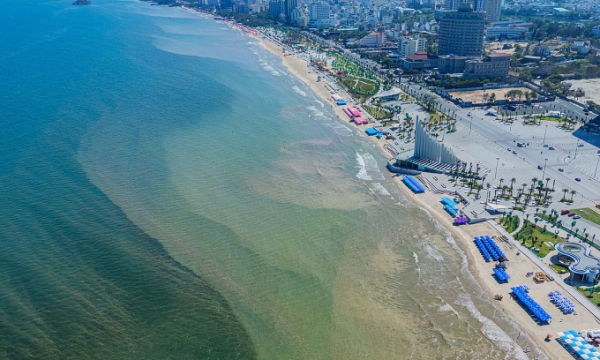
Between April 4 and 5, seawater along the 10-kilometer stretch of Back Beach turned matcha-green, foamed and formed greasy slicks. At intervals, a pinkish-purple film spread across the surface, giving off the smell of decomposing algal biomass.
Over the following days, oil-like globs washed ashore and dead juvenile fish were scattered along the waterline. The neighboring Bai Dua area along Ha Long Street was fouled with marine debris including foam boxes, plastic bags, plastic bottles and tree branches. The phenomena eased by April 10, and water conditions returned to normal.
Algal slicks stretch across the water at Back Beach in Vung Tau on April 4, 2026. Photo by Read/Truong Ha |
The Vung Tau Ward People’s Committee submitted its findings this week to Ho Chi Minh City’s Department of Agriculture and Environment and Department of Science and Technology. Analysis of samples from five nearshore sites was conducted by the Institute of Coastal and Offshore Engineering under the Vietnam Academy for Water Resources.
Technicians identified 69 phytoplankton species across three major groups. Diatoms were the most diverse, with 46 species accounting for 66.67% of the species count. Dinoflagellates contributed 22 species, or 31.88%. Cyanobacteria contributed just one.
But that single species, Trichodesmium erythraeummade up between 99.53% and 99.91% of the biomass at every sampling point.
Trichodesmium erythraeum is a filamentous cyanobacterium that normally drifts offshore in tropical and subtropical oceans. Under calm conditions, its cells clump into floating bundles that, viewed up close, look like loose wood shavings. That is how marine biologists came to nickname it “sea sawdust.”
The species is also one of the ocean’s most important nitrogen fixers, pulling atmospheric nitrogen directly into the marine food web and feeding plankton communities in nutrient-poor waters.
When cells release their pink pigment as they decay, they can stain seawater in streaks of rust, brown and deep pink. Some marine-science references credit this exact phenomenon, observed in surface slicks across the Indian Ocean and Red Sea coast, with giving the Red Sea its name.
Although Trichodesmium blooms are not among the world’s most dangerous algal events, direct contact with dense mats can cause skin irritation and, in some cases, mild respiratory discomfort. Decomposing biomass is the source of the characteristic foul smell.
Marine health advisories in other countries that see regular Trichodesmium blooms, including Australia and the southeastern United States, generally recommend that swimmers avoid visibly scummy water and rinse off after any exposure.
Discoloration events on Vung Tau coastline have recurred in past years, but the organism behind them varies. A bloom in October 2025 turned the same waters an unusual shade of green, but laboratory analysis at the time traced that event to A sparkling nightingalea bioluminescent dinoflagellate better known for producing the blue glow sometimes seen in breaking waves at night.
Local scientists said the pattern of annual blooms is stable, but the species involved is not.
The Vung Tau Ward People’s Committee attributed the April bloom to a convergence of seasonal and local factors. The period fell within a prolonged stretch of hot weather and light winds that reduced ocean mixing, allowing cells to concentrate near shore.
Freshwater runoff from nearby rivers and canals simultaneously fed organic matter and nutrients into the coastal zone, creating favorable conditions for rapid growth. Warm water, calm seas and nutrient input from land are the drivers most commonly associated with Trichodesmium blooms worldwide.
Back Beach, a 10-kilometer arc of golden sand along Thuy Van Street, is one of southern Vietnam’s most-visited coastal destinations, drawing more than two million tourists a year. Formerly part of Ba Ria-Vung Tau Province, the area became a ward under Ho Chi Minh City following Vietnam’s July 2025 administrative restructuring, which merged the province and neighboring Binh Duong into the expanded municipality.
Contact to : xlf550402@gmail.com
Copyright © boyuanhulian 2020 - 2023. All Right Reserved.